You're standing in the backyard, looking at your fence. The wood has gone from a warm, rich tone to a faded gray. Maybe there are dark patches of algae. Maybe the old stain is peeling or has worn away unevenly. You know it's time to refinish — but then you start researching fence stains and discover a world of options that makes the decision feel overwhelming.
Transparent. Semi-transparent. Solid. Oil-based. Water-based. Cedar tone. Natural. Dark walnut. The choices seem endless, and the wrong decision means living with a fence that doesn't look right — or a finish that fails prematurely.
Here's the good news: choosing the right fence stain isn't about picking the most expensive product or the trendiest color. It's about understanding your wood, your climate, and your goals — and then matching the right finish to those factors. Let's break it down so you can make a confident decision.
Understanding Wood Species: Cedar vs. Pine vs. Hardwood
The wood species of your fence is the starting point for every stain decision. Different woods absorb stain differently, age differently, and require different approaches.
Cedar Fencing
Cedar is the most popular fencing wood in North Texas — and for good reason. It's naturally resistant to decay and insects, has a beautiful grain pattern, and accepts stain beautifully.
- ▸Natural color — warm, reddish-amber tone
- ▸Grain — prominent, attractive, worth showcasing
- ▸Stain absorption — excellent; cedar absorbs penetrating oils readily
- ▸Best stain types — transparent or semi-transparent to showcase the grain; cedar tones enhance the natural color
- ▸Aging — without protection, cedar turns gray from UV exposure within 1-2 years
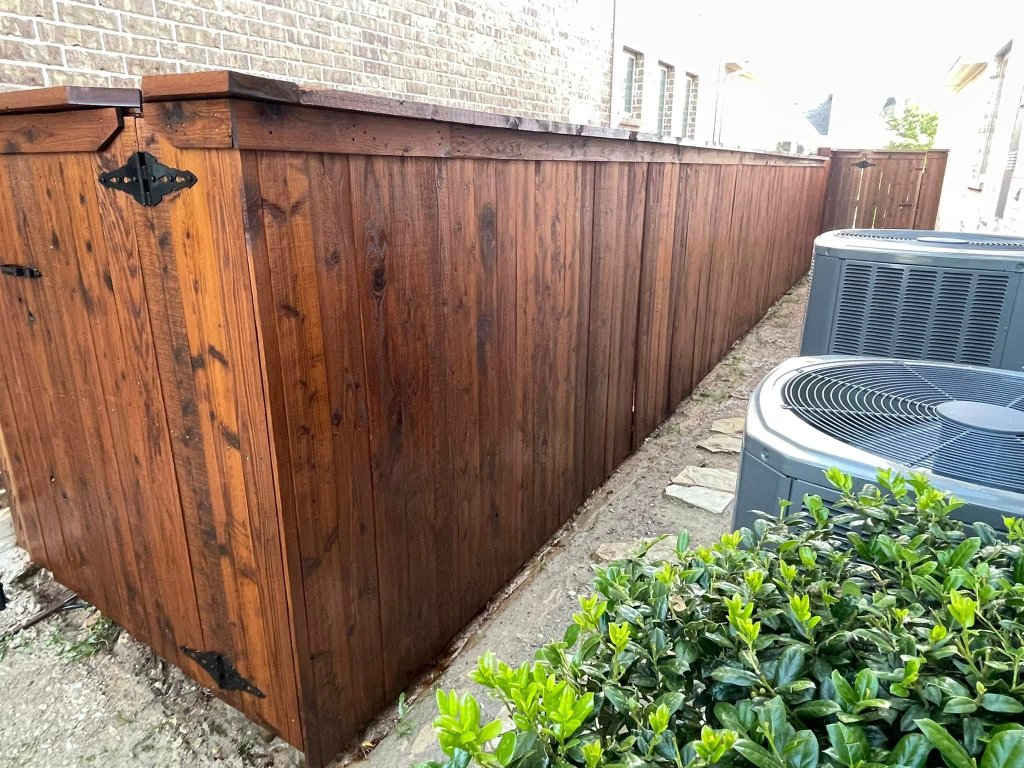
For cedar, the goal is usually to enhance the natural beauty while protecting against UV damage. Semi-transparent stains in cedar, honey, or natural brown tones are the most popular choice.
Pine Fencing
Pine is more affordable than cedar and widely used in pressure-treated fencing. It's a softer wood with a different character.
- ▸Natural color — pale yellow to light brown
- ▸Grain — less prominent than cedar; more uniform
- ▸Stain absorption — variable; can absorb unevenly without proper preparation
- ▸Best stain types — semi-transparent for color uniformity, or solid stains for a uniform, opaque finish
- ▸Aging — turns gray quickly without protection; more prone to checking and splitting
Pine often benefits from darker or more pigmented stains that even out the color and provide stronger UV protection.
Hardwood and Exotic Woods
Less common in Texoma fencing but worth mentioning — woods like cypress or composite materials may require specific stain products or preparation methods.
Why Wood Species Matters for Stain Choice
The wood species determines:
- ▸How much pigment the wood will accept
- ▸How evenly the stain will absorb
- ▸How much UV protection is needed
- ▸Whether the natural grain is worth showcasing (transparent/semi-transparent) or better covered (solid)
Before choosing a stain color, identify your wood species — or have a professional evaluate it as part of the project.
Understanding Stain Types: Transparent, Semi-Transparent, and Solid
This is the most important decision in the staining process. The stain type determines how the finished fence will look and how much protection it provides.
Transparent Stains
What they are: Stains with minimal pigment that soak into the wood fiber, providing a clear or lightly tinted finish.
Appearance: The natural wood grain and color are fully visible. The stain enhances rather than covers the wood.
UV protection: Low. Minimal pigment means less UV blocking.
Best for: New cedar or high-quality wood where you want to showcase the natural grain. Not ideal for older, weathered, or previously stained wood.
Maintenance: More frequent reapplication needed due to lower UV protection — typically every 1-2 years in North Texas sun.
Semi-Transparent Stains
What they are: Stains with moderate pigment that penetrate the wood while adding visible color.
Appearance: Color is visible, but the wood grain shows through. This is the sweet spot — enhancement with protection.
UV protection: Moderate to good. The pigment provides meaningful UV blocking while maintaining grain visibility.
Best for: The most popular choice for cedar and pine fences. Works well on wood in good condition that has been properly prepared.
Maintenance: Typically needs refreshing every 2-4 years in the Texoma climate.
Solid-Color Stains
What they are: Heavily pigmented stains that provide an opaque, uniform finish — similar to paint but penetrating rather than film-forming.
Appearance: The wood grain is hidden. The color is uniform and consistent across the surface.
UV protection: Highest. Maximum pigment provides maximum UV blocking.
Best for: Older fences, previously stained wood with uneven color, or when a uniform appearance is desired. Also good for pine where grain isn't as attractive.
Maintenance: Longest-lasting option — 3-5 years in North Texas. However, when it does need refreshing, it may require more surface preparation.
Choosing the Right Type
| Wood Condition | Recommended Stain Type | |---|---| | New cedar, want to show grain | Transparent or semi-transparent | | Cedar in good condition | Semi-transparent | | Pine, want uniform color | Semi-transparent or solid | | Older, weathered wood | Solid or semi-transparent | | Previously stained, faded | Semi-transparent (if compatible) or solid | | Want maximum UV protection | Solid | | Want to showcase natural grain | Transparent or semi-transparent |
Stain Colors: Finding the Right Tone
Once you've chosen a stain type, the color selection comes down to aesthetics, HOA requirements, and how the color complements your property.
Popular Fence Stain Colors in North Texas
- ▸Cedar / Natural Cedar — enhances the warm, reddish tones of cedar fencing; the most popular choice in Texoma
- ▸Honey / Amber — warm golden tone that brightens the wood while maintaining a natural look
- ▸Brown / Dark Brown — rich, earthy tone that complements brick homes and landscaped properties
- ▸Redwood — deeper red-brown that works well with cedar and red brick
- ▸Dark Walnut — dark brown, nearly espresso tone for a dramatic, modern look
- ▸Natural — very light tint that preserves the wood's original color with minimal change
- ▸Gray / Silver — increasingly popular for modern aesthetics; mimics the natural weathered look
Factors to Consider When Choosing Color
Home exterior — the fence color should complement your home's siding, brick, or paint color. A brown-toned stain complements brick; a cedar tone complements vinyl siding.
Landscaping — consider how the fence color works with your plants, trees, and hardscaping. Darker stains create a backdrop that makes greenery pop; lighter stains create a more open, airy feel.
Neighborhood aesthetic — look at neighboring properties. While you don't need to match exactly, a fence that's dramatically different can look out of place.
Sun exposure — darker stains absorb more heat, which can affect the wood surface temperature. On south- and west-facing fences, this is worth considering in North Texas heat.
HOA Considerations for Fence Staining
If you live in a community with a homeowners association, check the architectural guidelines before choosing a stain color. Common HOA restrictions include:
Approved Color Palettes
Many HOAs specify a list of approved stain colors or require that stains be in "natural wood tones." Bright, unconventional colors (blue, green, red, white) are often prohibited.
Pre-Approval Requirements
Some HOAs require you to submit a stain color sample for architectural committee approval before applying it. This process can take 2-4 weeks, so plan ahead.
Consistency Requirements
In some communities, fences must match or complement neighboring properties. This is especially common in neighborhoods where fences are shared or visible from the street.
Re-Staining Requirements
Some HOAs require fences to be maintained in good condition and may send violation notices if staining has faded or peeled significantly. This is similar to the HOA notices for dirty homes that address siding and driveway maintenance.
Always check your HOA guidelines and submit color samples for approval before starting a staining project. Violating HOA stain guidelines can mean having to restain the entire fence — an expensive mistake.
The North Texas UV Factor: Why Preparation Matters
In the Texoma area, UV radiation is the primary enemy of exterior wood finishes. Our intense summer sun breaks down stain pigments and the lignin in wood fibers, causing:
- ▸Fading and color loss
- ▸Graying of unprotected wood
- ▸Peeling and flaking of film-forming finishes
- ▸Surface degradation that makes refinishing harder
This is why proper wood preparation before staining is critical. Stain applied over weathered, contaminated, or degraded wood won't absorb evenly, won't perform properly, and won't last.
The Proper Wood Preparation Process
Quality fence staining starts long before the stain is applied. The wood must be properly prepared:
- ▸Cleaning — a sodium metasilicate wood cleaner loosens oils, dirt, weathered residue, and organic buildup from the surface grain
- ▸Controlled-pressure rinsing — loosened residue is removed with controlled water pressure appropriate for the wood condition — not aggressive blasting that damages wood fibers
- ▸Oxalic acid brightening — an oxalic acid brightener neutralizes the alkaline cleaning step, restores natural wood tone, and reduces discoloration
- ▸Final rinse and drying — the wood is thoroughly rinsed and must reach suitable moisture conditions before staining
This four-step process — not harsh bleach-only cleaning or high-pressure blasting — is what creates a surface ready for an even, lasting stain application.
Why Bleach-Only Cleaning Falls Short
Strong bleach-only cleaning can affect the lignin in wood, raise fibers, shift the surface pH alkaline, lighten wood unevenly, and corrode metal hardware. It doesn't produce the clean, sound, properly conditioned surface needed for a quality stain application. This is why professional wood restoration uses a more deliberate, surface-aware process.
Who Performs Wood Restoration & Staining in Texoma?
Wood Restoration & Stain services requested through Texoma Pressure Washing are completed by our trusted partner, North Texas Pressure Wash — a professional exterior-cleaning and wood-restoration company serving the North Texas area.
Their team specializes in proper wood preparation before staining:
- ▸Sodium metasilicate wood cleaner application
- ▸Controlled medium-pressure rinse calibrated to wood condition
- ▸Oxalic acid wood brightener and neutralizer
- ▸Final rinse and drying period evaluation
- ▸Stain, re-stain, or paint application per approved plan
- ▸Protection of surrounding landscaping, masonry, and hardware
This isn't a quick blast-and-go pressure washing service. It's a deliberate, surface-aware restoration process designed to give the new stain the cleanest, most consistent surface possible.
Service Areas
North Texas Pressure Wash serves the North Texas area, including:
- ▸Sherman, Denison, and Pottsboro — core Texoma communities
- ▸Celina, Prosper, McKinney, Allen, Frisco, Anna, and Melissa — extended partner coverage areas
- ▸Surrounding communities across North Texas
To confirm availability for your specific project, submit your property details through the Wood Restoration & Stain service page.
The Staining Timeline: What to Expect
If you're planning a fence staining project, here's what the process typically looks like:
Step 1: Request an Estimate
Submit your project details — fence type, wood species, approximate size, and photos if possible. Select "Wood Restoration & Stain" as the service. Your request will be routed to North Texas Pressure Wash for evaluation.
Step 2: Wood Evaluation
The team reviews wood species, age, surface condition, existing coating type, and your desired outcome to determine the right approach. Not every fence is a candidate for restaining — if the wood is too degraded or the existing coating is incompatible, they'll let you know.
Step 3: Surface Preparation
The four-step cleaning process is completed: cleaner application, controlled rinse, brightener application, and final rinse. The wood must then dry adequately before staining.
Step 4: Stain Application
The selected stain is applied according to the approved project plan and product specifications. The stain type and color should be finalized before this step — and HOA approval should be secured if required.
Step 5: Final Inspection
The completed finish is reviewed, the work area is cleaned, and the project is walked through with you to confirm the results.
Important: Drying Time
The wood must reach suitable moisture conditions before stain is applied. Drying time depends on weather, temperature, humidity, shade, airflow, wood species, board thickness, and moisture content. Staining on the same day as cleaning is not guaranteed. Rushing this step compromises the finish.
Making the Right Choice for Your Fence
Choosing the right fence stain comes down to four decisions:
- ▸Stain type — transparent, semi-transparent, or solid (based on wood condition and desired appearance)
- ▸Color — cedar, honey, brown, walnut, or natural (based on wood species, home exterior, and HOA guidelines)
- ▸Preparation — proper four-step wood cleaning before staining (essential for an even, lasting finish)
- ▸Application — professional application by a team that specializes in wood restoration
Get these four decisions right, and your fence will look beautiful and perform well for years in the North Texas climate.
Ready to Restore Your Fence?
If your fence is weathered, faded, or ready for a fresh coat of stain, our trusted partner can help. Wood Restoration & Stain services requested through Texoma Pressure Washing are completed by North Texas Pressure Wash, who specializes in proper wood preparation and staining for fences, pergolas, decks, garage doors, and exterior trim.
Request a free evaluation or call (903) 444-2704 — select "Wood Restoration & Stain" as your service, and your request will be routed to the North Texas Pressure Wash team for project evaluation.
Want to learn more about protecting your home's exterior? Explore our full range of exterior cleaning services, or read about how North Texas weather affects your home's exterior.
Frequently Asked Questions
Related Service
Wood Restoration & Stain
Professional wood cleaning, preparation, and staining for fences, pergolas, decks, garage doors, and exterior trim. Completed by our trusted partner, North Texas Pressure Wash.
Learn About This Service